Informative
How to write a one-page customer data handling policy
Your team already follows rules about customer data. They just live in your head. Here is a fill-in outline to put them on one page.
Zinwe team · · 3 min read
A new hire asks: "Can I email the client list to my Gmail so I can work from home tonight?" You know the answer. But if it lives only in your head, every new person has to guess, and guesses vary.
Short answer: a data handling policy for a small business is one page of house rules, written in plain words. It answers four questions: who can see what, where files are kept, how they are shared and what to do if something goes missing. Fill in the outline below in about 30 minutes, then read it aloud to the team.
What is a data handling policy, really?
It is not formal paperwork or a contract. Think of it as the office's internal data rules, written down so nobody has to ask twice. One page is enough. If it runs longer, people stop reading.
Good rules are specific. "Be careful with data" helps nobody. "Customer lists stay in the Sales folder and never go to personal email" is a rule a person can follow.
What goes on the one page?
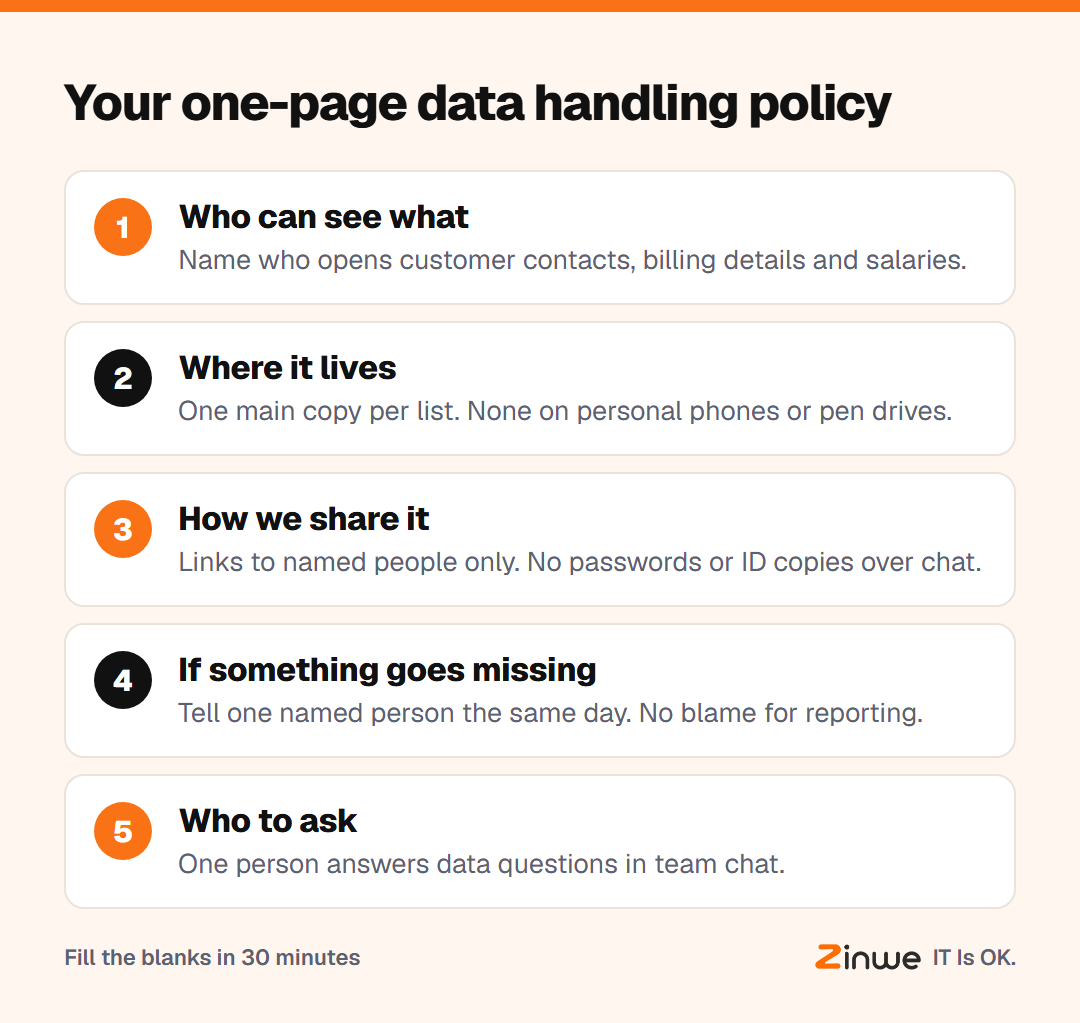
Copy this outline and fill the blanks:
- Who can see what. Customer contacts: ____. Bank and billing details: ____. Salaries: owner only.
- Where it lives. The main copy of each list is kept in ____. No copies on personal phones, pen drives or home laptops.
- How we share it. With customers: ____ (for example, a link to named people, never "anyone with the link"). Never sent over chat: passwords, full card numbers, ID copies.
- If something goes missing. Tell ____ the same day, even if you are unsure. Nobody is blamed for reporting.
- Who to ask. Questions go to ____ in team chat.
For the "never sent" line, our list of what you should never send over email or chat is a ready starting point.
How do you get the team to follow it?
Picture a 15-person freight forwarding firm in Visakhapatnam. The owner fills in the outline on a Saturday morning. On Monday she reads it out at the team meeting, takes two questions and changes one rule that did not match how the shipping desk really works.
Then she pins it next to the printer and adds it to the joining pack for new staff. Six months later she rereads it, finds one outdated folder name and fixes it.
These information handling guidelines work because the team helped shape them, and because they are short enough to remember.
In short
- One page, four questions: who sees what, where it lives, how it is shared, what to do if lost
- Write rules a person can follow, not general advice
- Read it aloud, adjust it, and reread it twice a year
Zinwe won't write your policy, but it helps you see when files leave by pen drive or as large email attachments, so you can ask about it early. Start free for 3 PCs.