Informative
Why your business may be losing hours without noticing
Hours rarely vanish in one go. They leak away through late starts, drifting breaks, waiting and app hopping. A visible work day shows where.
Zinwe team · · 3 min read
Nobody walks off with a whole afternoon. It leaks away ten minutes at a time: a slow start, a break that runs on, a wait for your reply. By Friday the week feels short, and nobody can say why.
Short answer: lost hours usually come from four quiet leaks: late starts, long unplanned breaks, waiting for answers and hopping between tools. Simple time tracking for small business, where each person logs in, takes breaks and logs out on their own PC, makes these leaks visible. Once you can see them, most are easy to fix.
What are the four leaks?
- Late starts. The office "opens" at 9.30, but real work begins after tea, email and a chat about last night's match.
- Long unplanned breaks. A ten-minute break becomes forty because nobody notes when it began.
- Waiting for answers. Work stops while someone waits for the owner to approve a quote or a refund.
- Tool hopping. Switching between email, chat, a spreadsheet and the billing app, and losing the thread each time.
None of these looks like lost productivity in the moment. Each feels like a normal part of the day.
How does time tracking for small business show the leaks?
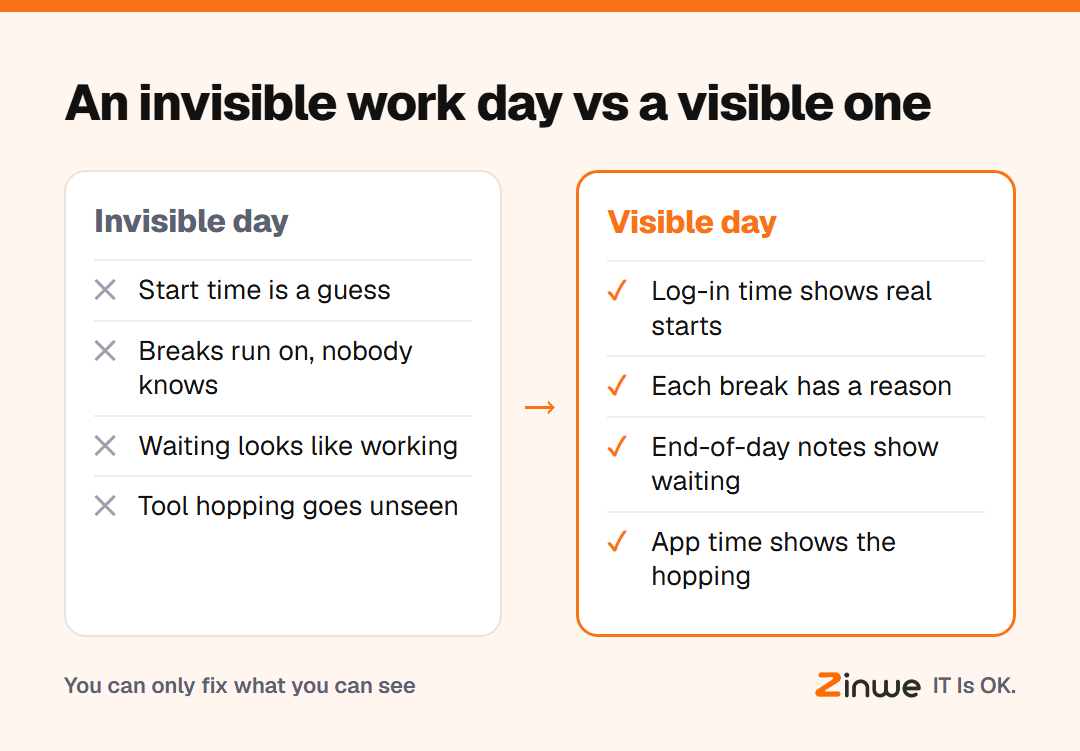
When the day is visible, patterns jump out. You see that starts drift on Mondays. You see breaks with no reason that run long. Ask for a one-line note at log-out and you notice how often "waiting for approval" turns up. App time shows the hopping.
The point isn't to time people. It's to do some honest work time analysis on the day as a whole.
What do you do once you see them?
- Agree a start time and keep it yourself first.
- Ask for a reason with each break. "Lunch", "bank", "doctor". It sets a natural length without rules.
- Approve faster. If people wait on you, set two fixed times a day to clear approvals.
- Cut one tool. If two apps do the same job, pick one.
Take a 15-person staffing agency in Charlotte. The owner thought the team started at nine. A month of log-in times said closer to half past, mostly on days he arrived late himself. He started arriving on time and set a midday slot for approvals. The afternoons got their hours back without a single new rule.
In short
- Hours leak through late starts, long breaks, waiting and tool hopping
- A visible day shows the leaks; it doesn't need to time people
- Fix the pattern, often starting with your own habits
Zinwe lets each person log in, take a break with a reason and log out, and you can approve or decline breaks. See how to approve or deny breaks, or start free for 3 PCs.