Informative
How better privacy habits help customers trust you
Customers rarely see your security, but they do see your habits. Five small ones, and one honest sentence, quietly build trust.
Zinwe team · · 3 min read
A client sends a photo of their passport over chat. You reply: "Thanks. I'll delete this from the chat once I've saved it to your file, and next time you can use our upload link." It takes ten seconds. The client remembers it for months.
Customers never see your firewall or your folder permissions. They see how you handle their details in the moments they are watching.
Short answer: you build customer trust through small, visible privacy habits. Ask only for what you need, take care with screenshots, confirm before you send, answer data questions clearly and tidy up when a job is done. Then say so in one plain sentence.
Which privacy habits build customer trust?
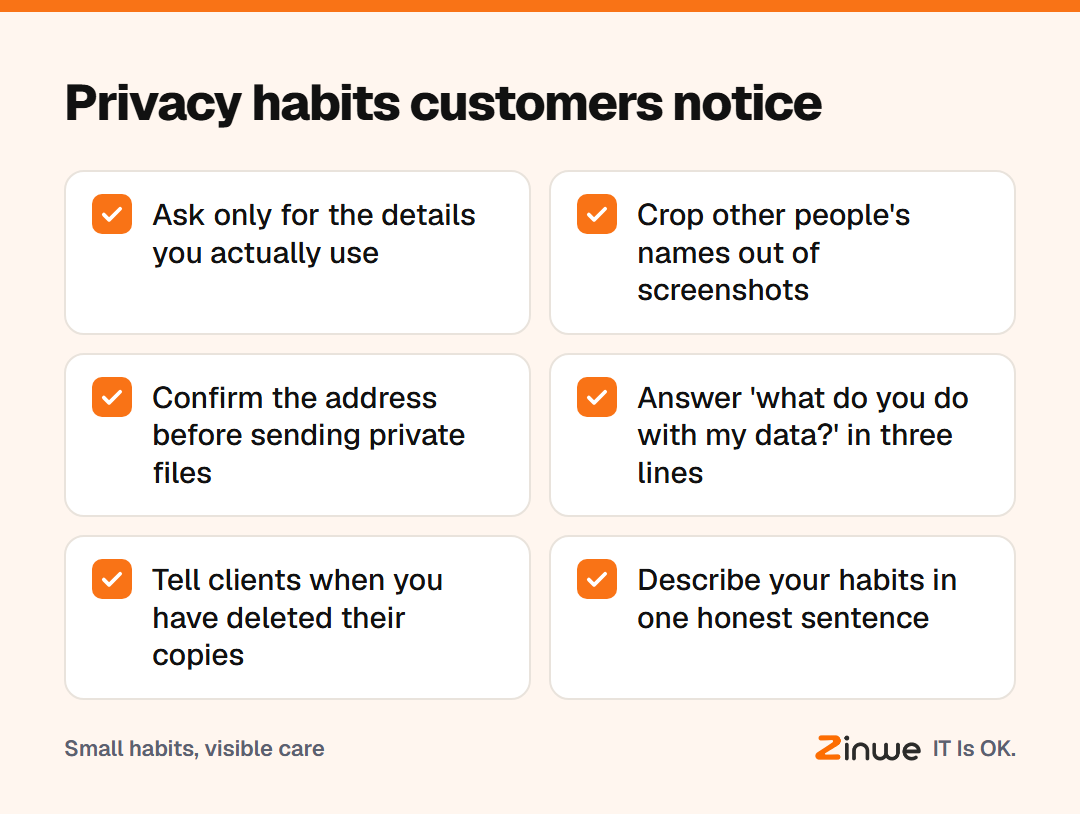
- Asking only for what you need. If a form asks for a date of birth you never use, people wonder why. Remove the field.
- Careful screenshots. Before sharing a screen or a screenshot, crop out other customers' names, numbers and open chats.
- Checking before sending. "Just confirming, is this the right email for the invoice?" shows care, not slowness.
- A clear answer to "what do you do with my data?" Who sees it, where it is kept and when you delete it, in three short lines.
- Tidying up. Telling a client "we've removed your ID copy now the check is done" is rare, and memorable.
How do you use privacy as a selling point without overpromising?
Keep it modest and true. One line in your proposals or on your website is enough, for example: "We only ask for what we need, keep it in one place and delete copies when the work is done."
Avoid big words like "fully secure". Nobody can promise that, and careful customers know it. A specific habit sounds more trustworthy than a grand claim.
What does this look like in a small firm?
Picture a 5-person wealth-planning practice in Columbus. They cut their new-client form from two pages to one. They agree that screenshots sent outside the firm get cropped first. They add a short "How we handle your documents" note to the welcome email.
Nothing about their software changed. But new clients start mentioning the welcome note, and one referral mentions how careful they seemed. That is customer trust and privacy working together, quietly.
In short
- Customers judge you by the habits they can see
- Ask less, crop screenshots, confirm before sending, tidy up afterwards
- Describe your habits in one honest sentence, not a big promise
For front-desk and sales moments, use our privacy checklist for handling customer details. Behind the scenes, Zinwe tells you when customer files are copied off a Windows PC to a pen drive. Start free for 3 PCs.