Informative
Employee monitoring and trust, and how to balance them
Monitoring breaks trust when it is hidden or aimed at people. Done openly and aimed at company data, it can protect both the business and the team.
Zinwe team · · 3 min read
Imagine finding out, six months into a job, that your work laptop had been reporting on you all along. Nothing bad happened. You still wouldn't feel the same about your boss.
That feeling, not the software, is what damages a team. And it is entirely avoidable.
Short answer: employee monitoring software and trust can sit together when four things are true. Your team knows about it. They can see it on their PC. It looks at company data and the work day, not at people's private lives. And each person has a real choice to agree or decline.
Why does monitoring so often break trust?
Usually because of how it arrives, not what it does. Trust breaks when:
- People find out by accident
- Nobody explains why it is there
- It collects far more than the business needs
- The first time it comes up is in an accusation
Each of these says "we don't trust you" louder than any policy could.
What are the four tests of fair employee monitoring software?
Ask yourself these before you switch anything on.
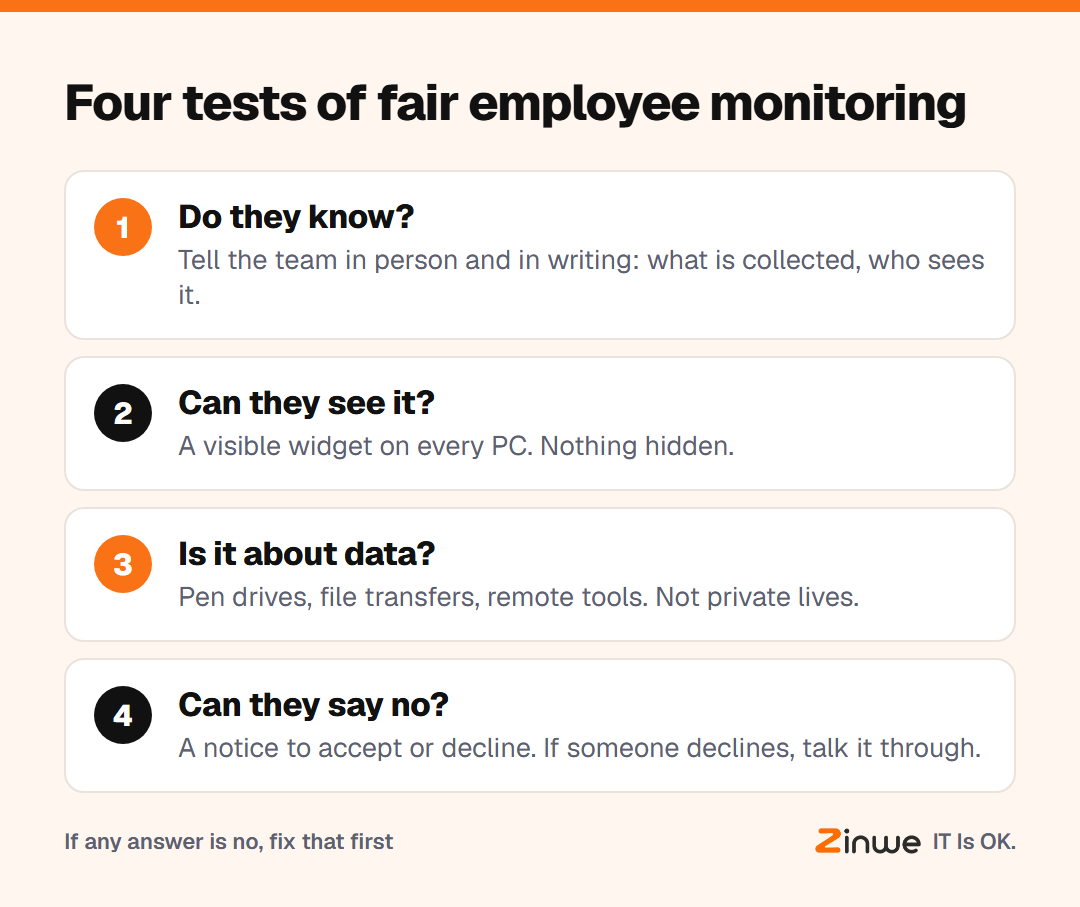
- Do they know? Tell the team in person, then in writing. Say what is collected and who sees it.
- Can they see it? A visible widget on the PC is a daily reminder that nothing is hidden.
- Is it about data, not people? Pen drives, large file transfers, remote-access tools and new software protect the business. Reading private chats protects nobody.
- Can they say no? A notice they can accept or decline is a real choice. If someone declines, talk it through and find out what worries them.
What does workplace transparency look like day to day?
It is mostly small habits. Share what you look at, and why. When something odd shows up, ask before you assume. Treat employee privacy as part of the deal, not a favour.
Take a 10-person video production house in Seattle. The owner wanted to know when client files left the office. She explained the plan at a Monday stand-up, showed the widget, and said plainly that screens and messages were off limits. One editor asked if her music app would show up. Yes, by name and time, and that was fine. Months later, a file-copy alert led to a two-line chat, not a confrontation.
In short
- Hidden monitoring costs more trust than it protects
- Tell them, show them, watch data, let them choose
- Ask before you assume, every time
This is ethical employee monitoring in practice. Zinwe is built that way: each employee sees a notice on their own PC and agrees or declines. If they decline, nothing is collected from that PC. And it never records screens or reads messages. Read Zinwe in 5 minutes, or see what activity tracking should mean.