Informative
How to see team progress without asking for updates
Every 'any update?' message interrupts the person doing the work. Three fixed moments in the day give you better answers with far fewer pings.
Zinwe team · · 3 min read
"Any update?" might be the most common message in a small office. It takes two seconds to send. It costs the person who receives it their focus, and the reply is nearly always "working on it".
Send it five times a day and you have also told your team, without meaning to, that you aren't sure they're working.
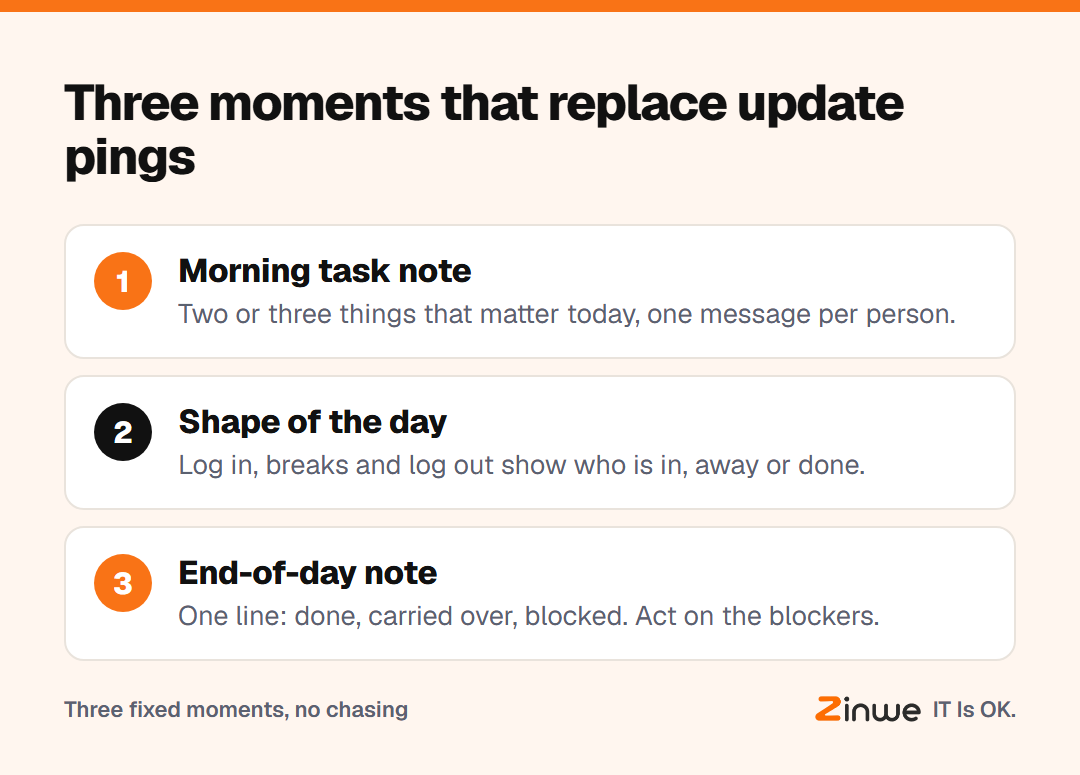
Short answer: good team productivity management doesn't need constant check-ins. Replace the pings with three fixed moments: a morning task note, a look at the shape of the day, and a short end-of-day note. You get clearer answers and your team gets its focus back.
Why do "any update?" messages backfire?
- They break concentration at random times
- They sound like doubt, even when you're only curious
- The answers are vague, so you ask again later
- You become the person everyone reports to, all day
What does team productivity management look like without pings?
1. A morning task note
Start the day with one message per person: the two or three things that matter today. You can send it ("Task for today: finish the Mehta brochure") or ask each person to post their own.
2. The shape of the day
If your team logs in, takes breaks and logs out on their PC, you can see who has started, who is on a break and who is done. That answers "are they in?" without a single message. It tells you nothing about what they type, and it shouldn't.
3. An end-of-day note
Before logging out, each person writes one line: done, carried over, blocked. That is team progress tracking at its lightest, and the blockers are the part you act on.
How do you stop this feeling like checking up?
Employee accountability works best when it runs both ways.
- Follow the same routine yourself. Post your own three things.
- Reply to blockers fast, or the notes stop coming.
- Say thank you when something ships. A short note counts.
- Trust the read receipt. If a message shows as seen, wait for the reply.
Take a 14-person marketing agency in Minneapolis. The founder used to message each designer two or three times a day. She switched to a morning task note and a one-line evening wrap-up. Within a week the notes showed that most delays came from waiting on client feedback, not from the team. She started chasing clients instead.
In short
- Pings cost focus and rarely tell you much
- Morning task, shape of the day, evening note
- Act on blockers; leave the rest alone
Zinwe's team chat has ready-made notes like Task for today, Log your day and Thank you, with Sent, Delivered and Seen ticks. See how to chat with your team in Zinwe, or read why busy isn't always moving.